Looking for land near Tensed is exciting, but raw acreage only tells part of the story. If you want room for a small farm, livestock, a future homesite, or a long-term land investment, you need to know how the ground lays, what county rules allow, and how much of the property is truly usable. This guide will help you understand what to expect from acreage and small-farm opportunities near Tensed so you can shop with more confidence. Let’s dive in.
Why Tensed Appeals to Acreage Buyers
The Tensed area offers a rural land market that looks very different from a typical suburban search. Public listing snapshots show a mix that includes small in-town lots, but the bigger pattern is mid-sized and larger acreage, with examples such as 5-acre, 10-acre, 20-acre, 36-acre, 38-acre, 120-acre, and 150-acre parcels.
That fits the broader agricultural profile of Benewah County. According to the 2022 Census of Agriculture, the county had 240 farms covering 130,471 acres, with an average farm size of 544 acres. At the same time, the farm-size distribution was centered heavily in the 10- to 179-acre range, which makes the area especially relevant for buyers looking for manageable rural holdings rather than only very large operations.
What Small-Farm Land Near Tensed Is Best Suited For
If you are picturing irrigated row crops on a large scale, Tensed may not be the right fit for every parcel. County agriculture data shows only 127 irrigated acres reported countywide, which points to a market better suited to dryland or lightly irrigated uses unless a specific property has a strong water plan.
In practical terms, the area is often a better match for:
- Pasture
- Hay production
- Small grains
- Limited livestock setups
- Timber management
That local pattern also lines up with the USDA description of the Tensed soil series. These soils are used mainly for crop production and timber production, especially small grains, hay, and pasture, in a climate with about 23 to 27 inches of annual precipitation and a frost-free period of roughly 90 to 130 days.
Expect More Than Flat, Open Ground
One of the biggest mistakes buyers make with rural property is assuming all acreage works the same way. Near Tensed, the land can sit on dissected terraces and foothills, with slopes ranging from 3% to 35%.
That matters because a beautiful parcel on paper may have real-world limits when it comes to building, fencing, equipment access, or year-round use. A property with steeper sections may still be very valuable and usable, but the best homesite, driveway route, and pasture layout may not be obvious from a listing photo.
Some Tensed-area soils may also have a seasonally perched water table from February to April. That does not mean a parcel is unusable, but it does mean drainage, building pad placement, and access planning deserve close attention before you close.
What Improvements You May Find
Acreage listings around Tensed can include more than vacant land. Current examples in the market have included properties with modest homes, larger ranch-style residences, ponds, streams, springs, pasture, trees, and agricultural features such as a grain silo.
That variety can be a real advantage if you want a property that is already partially set up for rural living. It also means you should look carefully at how each improvement supports your goals. A barn, outbuilding, pond, or fenced area may add value, but only if it fits how you plan to use the land.
County Rules Can Shape Your Options
With acreage near Tensed, county rules are not a side issue. They directly affect what you may be able to build, divide, or add later.
Benewah County makes an important distinction between rural and urban or suburban subdivision patterns. Rural subdivisions are those where all resulting parcels are 5 acres or larger, while urban or suburban subdivisions include any parcel under 5 acres.
There are also rules for independent parcel divisions that do not require subdivision approval. Those now have a 1-acre minimum, require 75 feet of frontage on public roads, and require legal descriptions plus legal practical access by easement or other recorded access.
Another key detail is that parcel divisions where every resulting parcel is 20 acres or larger are exempt from the subdivision title. If you are thinking about a future split, a family compound, or holding land for long-term planning, this is one of the first areas to review carefully.
Building Plans Start With Septic Review
If your goal is to build a home, guest residence where allowed, or another sewage-generating structure, septic approval is a major early checkpoint. Benewah County requires septic permit approval from the regional health district official before a house or other sewage-generating structure is permitted.
In rural subdivisions, county code allows individual or shared wells and septic systems when public systems are unavailable. However, those systems do not need to be installed before final plat, which means buyers still need to verify what is approved, what is feasible, and what costs may be involved.
This is especially important for buyers planning multi-generational living or multiple structures. Even if a parcel looks large enough, the practical questions are whether zoning allows the intended setup, whether septic capacity supports it, and whether access and frontage satisfy county rules.
Agricultural Buildings Have Special Rules
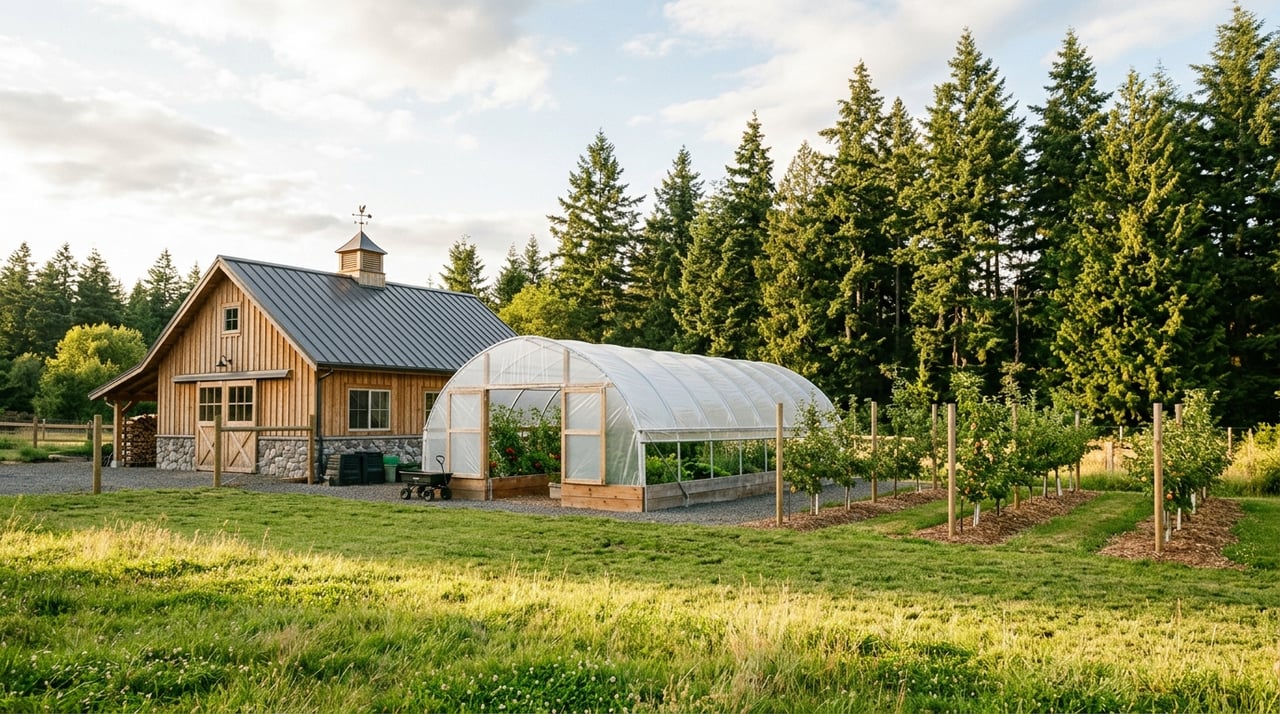
If your plans include working farm structures, Benewah County specifically recognizes agricultural buildings such as:
- Livestock shelters
- Poultry buildings
- Barns
- Equipment storage buildings
- Greenhouses
- Sheds
- Grain silos
- Stables
When a structure is used solely for those agricultural purposes on land classified by the assessor as actively devoted to agriculture, it is exempt from county building code requirements. Even so, it still must meet zoning placement rules, must obtain a site permit, and cannot be used as a dwelling or public-use building.
This is a great example of why acreage buyers need more than a simple yes-or-no answer. A building may be allowed in one context but not in another, depending on how the property is classified and how the structure will actually be used.
Livestock Plans Need Practical Due Diligence
If animals are part of your vision, be sure to look beyond acreage count alone. Benewah County’s livestock control ordinance prohibits livestock from running at large and requires lawful fences.
That means fencing condition, boundary clarity, terrain, and access all matter. A property may have enough acreage for livestock in theory, but if the fencing is poor or the layout is awkward, your startup costs and management needs may be higher than expected.
The county also states that owners, buyers, transferees, lenders, and other parties are responsible for their own compliance review rather than relying on the county. For you as a buyer, that makes careful verification a must.
A Smart Way to Evaluate Tensed Acreage
When you tour acreage near Tensed, try to think beyond the headline number of acres. A better approach is to evaluate each parcel based on the features that affect day-to-day use and long-term flexibility.
Here is a simple checklist to guide your review:
- Topography: How steep is the ground, and where is the most usable area?
- Access: Is there legal practical access and adequate road frontage?
- Water: Does the parcel have a realistic plan for well, irrigation, or seasonal drainage?
- Septic: Has septic feasibility or approval been addressed for your intended use?
- Improvements: Do homes, barns, sheds, ponds, or fencing add real function?
- Future plans: If you want multiple households or a future split, do county rules support that idea?
- Agricultural fit: Does the soil and terrain match your intended use, such as pasture, hay, or timber?
This kind of review can save you from buying land that sounds good in a listing but does not line up with your actual goals.
Local Support Can Make a Difference
If you are new to rural property ownership, you do not have to figure everything out alone. Benewah SWCD offers non-regulatory technical, financial, and educational assistance to landowners, and University of Idaho Extension provides small-farm programming and one-on-one consultations for specialty crop, livestock, organic, value-added, and agri-tourism enterprises.
For many buyers, that kind of support can be helpful when moving from a general dream of owning land to a more practical plan for using it well. It is one more reason to view acreage as a long-term asset that benefits from local knowledge.
Why Local Guidance Matters
The value of acreage near Tensed often comes down to flexibility. You may find a small parcel near town, a larger ranch setup, or a former farm tract with a mix of open ground, timber, and water features.
But the difference between a good purchase and a frustrating one is usually not just price per acre. It is how soil, slopes, access, septic, outbuildings, and county rules come together on a specific property.
That is where local experience matters. When you work with someone who understands North Idaho rural property, you can ask better questions, spot issues earlier, and make a decision that fits both your lifestyle and your long-term plans.
If you are exploring acreage or small-farm property near Tensed, Mia Suchoski can help you evaluate land with a practical, local perspective.
FAQs
What parcel sizes are common near Tensed?
- Public listing snapshots suggest the market often includes mid-acreage and larger rural parcels, with examples ranging from about 5 acres to 150 acres, along with occasional smaller in-town lots.
What agricultural uses fit land near Tensed best?
- Based on the local ag profile and soil information, the area is often a strong fit for pasture, hay, small grains, limited livestock, and timber management.
What should buyers know about building on acreage near Tensed?
- Before a house or other sewage-generating structure can be permitted, Benewah County requires septic permit approval from the regional health district official.
What should buyers know about dividing land in Benewah County?
- Parcel division rules depend on resulting parcel sizes, frontage, access, and whether the division falls under subdivision rules, so buyers should verify those details early if a future split matters.
Are farm buildings treated differently in Benewah County?
- Yes. Certain agricultural buildings may be exempt from county building code requirements if they are used solely for agricultural purposes on land actively devoted to agriculture, but zoning placement rules and site permits still apply.
Is irrigated farming common near Tensed?
- County agriculture data shows very limited irrigated acreage, so many properties are a better fit for dryland or lightly irrigated uses unless the parcel has a strong water plan.